The 1828 Blue House Cottage
A North Hatley, Quebec History
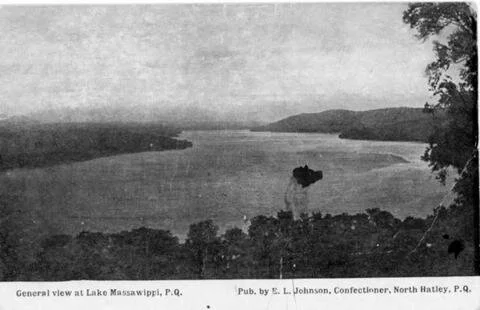
In 1801, Ephraim Wadleigh moved with his wife, three sons, and two daughters from Fisherfield, New Hampshire to live in Hatley, Quebec. Seventeen years later, in 1818, for 60 cents an acre he purchased a large tract of land at the northern part of Lac Massiwippi.
Speculators had already made a small clearing on the land which later would become the village of North Hatley. A log cabin was built, and the clearing was expanded for more pasture. As part of the land’s purchase conditions, Ephraim was required to cut a road from his new land through the forest to Magog which he completed in 1821, and In that same year, he sent his second son, Captain Taylor Wadleigh with his new bride Mathilda Hovey to settle on the land.
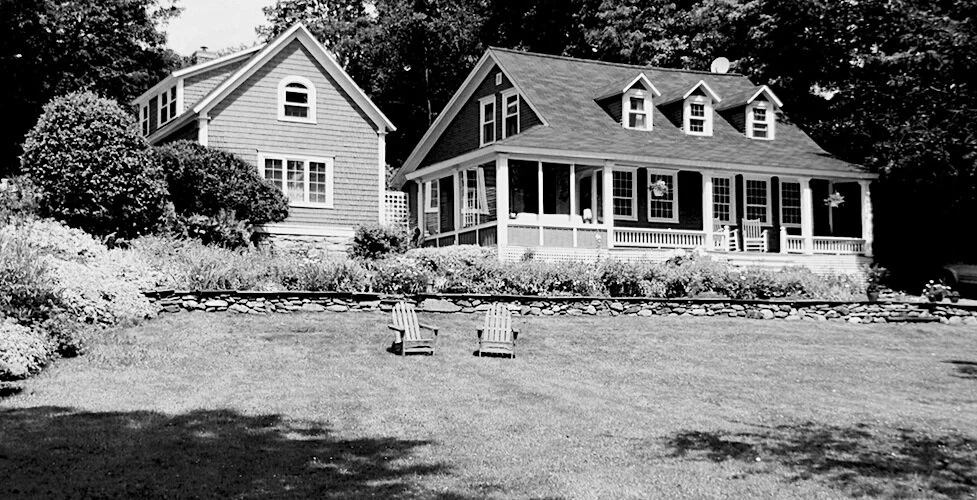
In 1828, with fewer than 100 people living in Sherbrooke, Taylor Wadleigh built the very first frame house in North Hatley. It was small, consisting of what is now the lounge and bedrooms above and very sturdily built, with heavy corner posts and heavy timbers that support the roof. The walls of the house were fully insulated with mud which was extremely rare at that time, and the construction employed a type of pin construction more often found in timber frame barns. A century and a half later, builders who were charged with renovating the house noted: “that the whole house could probably be rolled down the lake and remain intact without much structural damage at all.”
In 1866 Taylor Wadleigh died at the age of 67. At that time North Hatley had a post office, a store, and a small collection of buildings, and it was a smaller community than either East Hatley or Massawippi. It was not until 1870 that the first church would be built in North Hatley. Taylor Wadleigh's house passed to Judge R.N. Hall and later to G.A. Lebaron who purchased it in 1899. Horatio Wadleigh, Taylor's son who was the first person to be born in North Hatley was still living in the house. At the turn of the century with “his hair and beard as white as the Canadian hills." he moved to the cottage next door and lived with his two sisters.
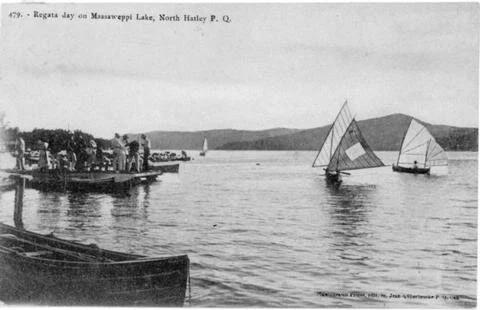
Before the turn of the century, the house had been expanded with a dining room, a small kitchen, and a front porch that was added to the house. A few years later, a storage shed was constructed onto one of the back corners of the house. The new owner of the house, G.A. Lebaron, was a music store owner from Sherbrooke, Quebec. He had begun to buy cottages around the North Hatley area as investments and then purchased a 100-acre parcel on the west side of the lake. North Hatley had started to become discovered by American visitors in 1886, the first summer cottage was built in 1891, and Lebaron saw an opportunity to build more cottages on his new acreage and add to his collection of cottages that he was already renting to summer visitors. On the west side pastureland, he planted 200 trees, laid out new lots for homes and cottages, and built new roads and that side of the lake's first public waterworks. Lebaron was later to build the first large summer hotel, Glen Villa which burned to the ground shortly after the turn of the century. Lebaron renamed his own house Dreamland Cottage and then rented it to a Mr. Frick and his daughter Mary who wrote, “The beach in front of the cottage is very pretty and fine for landing boats, being of gravel, while but a few steps takes one across the park to the bathhouse."
Later on in the summer of 1900, a New York artist, Maitland Armstrong rented the cottage, "sight unseen.” His daughter Helen wrote, “Plum Lebaron, drove us over from the station in his backboard, and as we drew near, Papa's face fell. The cottage stood at the top of a steep bank, brown already in June, with upright sections of clay pipe ranged in front of the abrupt porch, each filled with earth and supporting a magenta petunia. At one side stood an immense iron potash pot used for rendering soap in settler days, now overflowing with chickweed and more petunias. Across the roof, in yellow letters, a foot and a half high was written "Dreamland." Falling in love with the cottage and property, Maitland purchased it in 1902, and Dreamland Cottage would remain in his family for the next seventy years.
Maitland was described as a "small dapper man and a talented artist, specializing in the work of mosaics and design of stained glass windows." In 1915, the home was passed to Helen Maitland Armstrong and later, in 1944, Hamilton Fish Armstrong became its owner who then would pass it onto the last Armstrong owners Gregor Armstrong and Hamilton Armstrong’s daughter, Mrs Edwin Gamble. Maitland had initiated major renovations to the house. Windows were replaced and floors resanded. Adjacent to the house stood the property’s barn which at the time was full of manure and being used as an ice house. Maitland renovated the barn with one half of it designated as his artist studio, and the other half a bedroom which was then expanded with a new and higher roof that would accommodate a second bedroom and attic. Maitland also created the new garden terraces behind the main house, installed a tennis court on the front lawn, and laid out numerous flowerbeds. Several years later, the sunroom was built and the back corner shed was converted into a kitchen, toilet, and small storeroom.
In 1972 Ogden Glass, the Principal of Bishop’s University purchased the house and commissioned architect Phillip Webster to make significant design renovations. The front entrance through the porch was replaced by a window, a door was added between the porch and the sunroom, and a small corridor that was next to the fireplace in the living room was sealed off. Phillip Webster also shortened the dining room while at the same time expanding the kitchen to include part of the original dining room and a small pantry that existed at the back of the house. The bathroom, laundry room was added, and the kitchen's ceiling beams and windows including the large bay window were all added as part of the design and construction. In the main salon, the stairs were rebuilt to provide an easier angle at the top of the stairs a small bathroom was removed. On the second floor, a large main bedroom was created from two existing and smaller bedrooms and a former small sewing room at the top of the stairway and to the right was enlarged into a bedroom. A new bathroom and larger bathroom was created at the back of the upstairs in an area that was formerly a small corridor that led from one bedroom to another. Finally, The Glasses removed an arbor standing in the large, upper-level backyard area and installed an in-ground swimming pool.
In 1978, the property was acquired by Marcel Fox, a Quebec English School Board Administrator who performed more renovations to the barn and added onto the side of the main house, a small porch leading into the kitchen. Ten years later, Alice and John Oldland bought the property, added new flooring in the kitchen, and replaced the small bricks in the back patio with slate. In the barn, windows were replaced, and further insulation was added to complete winterizing work that Marcel Fox had begun.
In the spring of 2000, Peter and Kim Jacobs of North Ferrisburgh, Vermont purchased the property from the Oldlands and began an extensive redesign of the gardens and landscaping. At the time of the Jacobs’ purchase, overgrowth from old cedar hedges hid the house entirely from sight when standing directly in front of North Hatley’s Dreamland Park. The Jacobs removed trees, overgrown hedges, and shrubs, built new stone walls, added newly landscaped gardens, and opened up the home's beautiful views to Lac Massiwippi and the village of North Hatley. In the barn which previously only had one, small back door for access, a new front door was installed using vintage material including doorway corbels from an original Nantucket Captain's house. In 2007, The Jacobs acquired 140 feet of waterfront land to add to the main house, barn, and property.